Tattoo Aftercare Card Canva Template 2
First Impressions: Clean, Calm, and Client-Focused
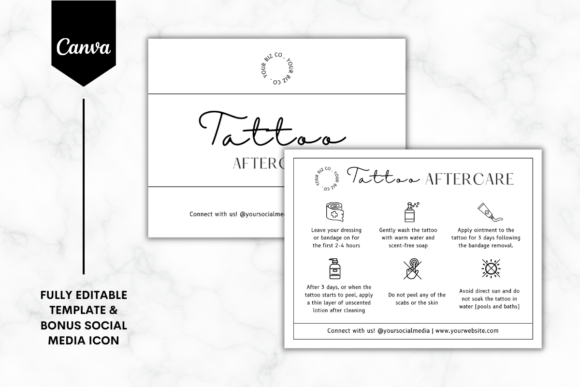
When I opened Tattoo Aftercare Card Canva Template 2, I didn’t see flashy graphics or aggressive branding—I saw quiet confidence. The layout is balanced, with generous white space, a soft but legible type hierarchy, and subtle visual cues (like a minimalist bandage icon or gentle line dividers) that guide the eye without competing for attention. It feels like something you’d hand to a client after their first tattoo—not as a legal disclaimer, but as a thoughtful, human gesture. That tone matters deeply when translating it into embroidery. Unlike bold logo designs or ornate monograms, this template leans into clarity over decoration, which makes it unexpectedly versatile for stitched applications.
A Real-World Test: Embroidering It onto a Linen Tote Bag
Last week, I used Tattoo Aftercare Card Canva Template 2 as the foundation for a custom embroidered tote bag—part of a small-batch launch for a local tattoo studio’s retail shelf. I resized the text block to fit a 4” × 6” hoop, kept the core instructions intact (“Wash gently,” “Pat dry,” “Avoid soaking”), and added a tiny anchor icon in the corner as a subtle studio signature. On natural linen, the result was clean, tactile, and professional—not stiff or overly graphic. Clients picked it up, read it immediately, and commented on how “thoughtful” it felt. That’s the power of a design that prioritizes readability and warmth: it stitches well *and* communicates trust.
Where It Shines in Embroidery Projects
- Custom apparel: Works cleanly on sweatshirt pockets, t-shirt hems, or sleeve tags—especially when simplified to key bullet points.
- Embroidered patches: The structured layout translates smoothly into satin-stitched borders and crisp fill-stitched text blocks.
- Baby embroidery: Paired with soft pastel thread on organic cotton onesies, it reads as gentle guidance—not clinical instruction.
- Holiday or boutique gifts: Stitches beautifully onto tea towels, pillow covers, or aprons sold at craft fairs or Etsy shops as “tattoo artist starter kits.”
- Commercial embroidery: Fits neatly into branded merchandise lines where consistency and calm authority matter more than visual noise.
Where to Proceed Thoughtfully
Tattoo Aftercare Card Canva Template 2 isn’t built for extreme detail—or tiny execution. If you’re planning to stitch it on a curved cap visor or a stretchy ribbed knit, simplify first: reduce line count, enlarge key phrases, and avoid tight corners where satin stitch can pucker. On dark fabric, test thread contrast early—light gray or off-white thread often reads better than stark white. On thin or textured fabrics (like slubbed linen or lightweight chambray), use medium-weight cutaway stabilizer to prevent shadowing or distortion in the lettering. And if your finished product will be washed frequently—think baby towels or kitchen linens—avoid dense fill-stitch areas in small text; running stitch or split-stitch outlines hold up longer.
What It Adds to Your Handmade Product—and What It Doesn’t
This template elevates perceived value without demanding technical gymnastics. When stitched onto a handmade tote or embroidered patch, it signals care, professionalism, and attention to client experience—not just ink, but aftercare. That builds trust faster than a generic “Thank You” tag. It also strengthens brand consistency: if you’re an Etsy seller bundling tattoo aftercare kits, using the same clean visual language across printed cards *and* stitched items creates cohesion. But it won’t replace thoughtful customization. You’ll still need to adapt spacing for your machine’s stitch behavior, adjust kerning for legibility at 3”, and choose thread colors that harmonize with your fabric—not just contrast.
Practical Designer Notes Before You Stitch
- Test the design on scrap fabric *first*, especially if using layered stabilizer or blending thread colors.
- Review stitch density—tight fills in small fonts may not resolve cleanly on low-thread-count cotton.
- Confirm your hoop size fits the intended layout; don’t force a 5” wide card into a 3.5” hoop without simplifying.
- Inspect corners and fine lines in your embroidery software—some Canva-exported graphics soften edges during conversion.
- Try black-and-white mockups to assess contrast before committing to thread choices.
- Compare how it reads on light vs. dark fabric backgrounds—what works on ivory linen may vanish on charcoal twill.
- Use appropriate stabilizer: cutaway for knits, tear-away for stable wovens, and fusible + cutaway for lightweight silks or rayons.
- Verify licensing terms before selling finished products or digital embroidery files—this is a Canva Graphics template, so commercial use depends on your Canva plan and attribution requirements.
Final Thought: A Quiet Tool With Real Impact
Tattoo Aftercare Card Canva Template 2 won’t stop conversations at a craft fair with flash—but it *will* earn quiet nods of recognition from fellow designers who know how hard it is to make practical information feel personal. It’s not a showstopper; it’s a steady hand. For embroidery designers building real businesses—whether stitching one-of-a-kind baby onesies, curating Etsy bundles, or supporting local tattoo studios—it’s a rare kind of asset: functional, adaptable, and quietly confident. Use it as-is for clean printable mockups, simplify it for delicate embroidery projects, or layer it into larger branded kits. Just remember: its strength lies in restraint. Let the message breathe—and your stitching will too.