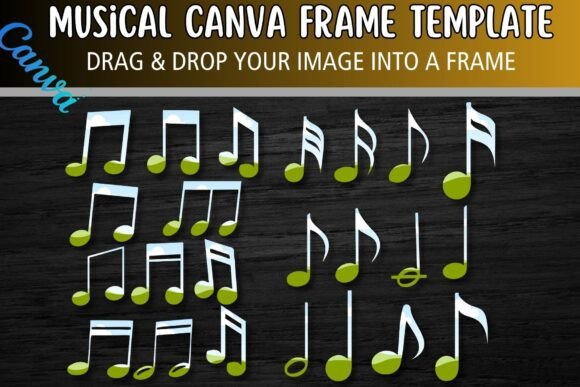
Musical Canva Frame Template
First Impressions: A Delicate, Playful Frame—Not a Standalone Embroidery Design
Opening the Musical Canva Frame Template feels like unrolling a sketchbook page—not a ready-to-stitch embroidery file. It’s clean, lyrical, and intentionally light: looping treble clefs, scattered eighth notes, and a soft circular or oval frame that invites customization. This isn’t a dense machine embroidery design with built-in satin stitch borders or layered fill stitch motifs. It’s a graphics-based template, built for Canva—not your embroidery software. That distinction matters deeply if you’re planning to translate it into a finished embroidered patch, tote bag design, or baby onesie.
Real-World Test: Stitching It Onto a Linen Kitchen Towel
I tested the concept by adapting the Musical Canva Frame Template for a small-batch holiday product: personalized linen tea towels for a local music teacher’s studio. My goal? A subtle, elegant accent—not a loud graphic. I resized the frame to fit a 4” hoop, added a short custom name in a clean sans-serif (via Canva), then exported as PNG and digitized it manually. The result was charming—but only because I treated the template as a starting point, not a plug-and-play embroidery file. On fabric, the thin lines of the music notes softened slightly; the open frame allowed breathing room around the text, which kept the final stitched piece feeling handmade, not clip-art-y.
Where It Shines (and Where It Needs Help)
- Custom apparel & sweatshirt embroidery: Works beautifully as a subtle chest accent on lightweight cotton or midweight fleece—especially when paired with minimal lettering. Avoid placing it over seams or stretchy side panels unless you’ve reinforced stabilizer.
- Embroidered patch & tote bag design: Great base shape for a sew-on patch. Just remember: the original template has no seam allowance or border stitching—add those yourself before digitizing.
- Baby embroidery & nursery decor: Its gentle rhythm and open layout make it ideal for onesies, burp cloths, or pillow covers—provided you simplify fine details (like tiny flag stems on eighth notes) for low-density stitching.
- Holiday embroidery & personalized gifts: Perfect for musical birthdays, recital favors, or teacher appreciation—especially when customized with names or dates in Canva first.
Use With Caution: Fabric, Fit, and Functionality
The Musical Canva Frame Template doesn’t auto-adapt to real-world embroidery constraints. Here’s where attention is non-negotiable:
- Small hoop sizes (under 3.5”): The frame’s delicate curves and note spacing can collapse visually. Simplify or enlarge key elements before digitizing.
- Textured or dark fabric: Fine lines disappear on burlap, terry cloth, or navy twill. Boost contrast with thicker outlines or switch to applique design techniques for clarity.
- Stretchy or thin fabric (e.g., baby knit, rayon challis): Requires cutaway stabilizer + careful hooping. The template’s openness helps—but without proper underlay and reduced stitch density, edges will flutter.
- Curved surfaces (caps, beanies): The circular frame *seems* cap-friendly—until you realize most cap hoops compress geometry. Test-fit the digitized version on a cap blank before committing.
- Frequent-wash items (kitchen towels, kids’ clothes): Avoid overly thin satin stitch sections. Reinforce note stems with running stitch underlay, and keep fill stitch areas sparse.
What It Adds—and What It Doesn’t Replace
This template elevates intention. It signals care, theme cohesion, and thoughtful personalization—especially for Etsy sellers curating a “musical lifestyle” collection. Customers notice when a gift feels curated, not copied. But it doesn’t replace embroidery expertise: no automatic thread color suggestions, no optimized stitch order, no built-in underlay for stability. You bring the craft; this brings the mood.
It strengthens brand consistency for small shop products—if used deliberately. Imagine three variations: one with “Maestro” in script for adult apparel, one with “My First Recital” in rounded type for baby items, and one with seasonal icons (a snowflake, a heart) swapped into the frame for holiday embroidery. That kind of flexibility is rare in pre-digitized files—and exactly why this Musical Canva Frame Template fits so naturally into a craft business workflow.
Practical Designer Notes Before You Stitch
- Always test the digitized version on scrap fabric matching your final project’s weight and texture.
- Check thread color contrast early—especially on dark fabric. Try black thread on cream linen, then reverse it.
- Review stitch density: thin music lines shouldn’t be filled; use outline or tapered satin stitch instead.
- Confirm hoop size compatibility *after* resizing—don’t assume the Canva canvas dimensions match your embroidery hoop.
- Inspect corners and intersections: tiny note flags or overlapping clef loops may need manual cleanup to avoid nesting or skipped stitches.
- Test in black-and-white mockups to assess visual weight and balance before stitching.
- Compare how it reads on light vs. dark backgrounds—some note placements vanish on busy prints.
- Use appropriate stabilizer: tear-away for stable cottons, cutaway for knits, and water-soluble for delicate tops.
- Verify licensing terms—since this is an editable digital embroidery file, confirm whether commercial use (e.g., selling finished embroidered patches) is permitted.
A Thoughtful Tool—Not a Shortcut
The Musical Canva Frame Template won’t save you hours of digitizing—but it might save you from generic, soulless designs. It’s the difference between slapping a stock music icon on a tote and offering a cohesive, customizable moment: quiet, intentional, and unmistakably handmade. For embroidery designers, Etsy sellers, and small shop owners who value both aesthetic control and emotional resonance, it’s less of a “file” and more of a quiet collaborator—one that asks for your judgment, rewards your care, and shows up gracefully in finished products customers actually keep.